|
Frontrower Rowing Facing Forward Modified for
Restricted Hip Motion or Rower with a Hip Replacement and The problem with
rowing at night. Gail Ferris |
|
The Frontrower is a solution for problem with rowing
at night and paddling into the wind. I have rowed and I have kayaked, and I just can't be
bothered any more with rowing backward or paddling without levers. I'm interested in achieving two goals. I
want to have the better-balanced, more complete exercise that rowing offers
and I want to be able to travel longer distances and tolerate stronger winds
and bigger waves. |
|
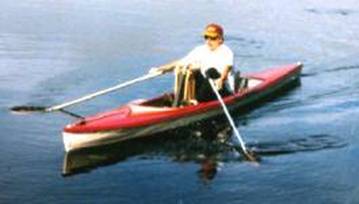
Frontrower in
Alden Ocean Shell single |
|
I've been pushing my luck with my single Alden Ocean
Shell. It is well-designed versatile hull with plenty of lift in the bow, and
if I time my stroke and control my direction, I can manage a steep 2-3 foot
chop. However I want something more capable of handling higher waves, and I
have two requirements. I want to row facing forward, and the secondly I want
to be able fly the oars as need be. A better hull is the Klepper Aerius II because it is
decked over leaving only the cockpit open and has a rudder which could be
modified for hand operation. I don't want to sacrifice the pleasures and
advantages that I know so well from kayak paddling. |
|
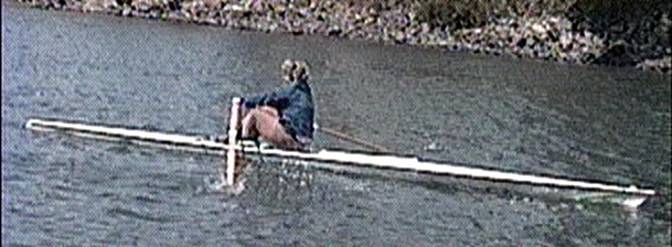
Alden Starr
at the pull showing normal rowing facing backward |
|
What’s wrong with traditional rowing is that when I
row facing backward making me feel that I am entering into the crystal ball
aspect of boat control. I am relegated to being the victim, and my response
to a wave is just a secondary correction. One of the biggest advantages of being a kayak
paddler is that because I am facing forward I can see and evaluate the waves
and interact directly with them. I prefer to be on the water at night because at night
I avoid the harshness of bright sunlight, and can take special pleasure in
solitude with the wanton freedom I savor on the nighttime sea. |
|
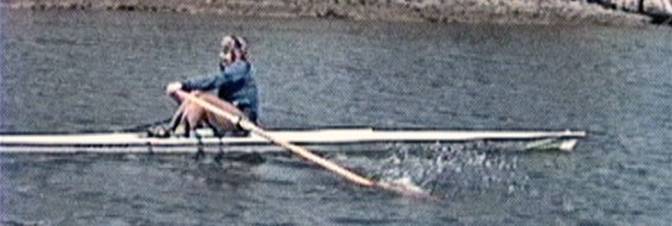
Alden Starr
at the catch showing normal rowing facing backward |
|
Facing forward while on the water at night makes being
able to see where I are going and what I are lined up to crash into much more
difficult than during daylight conditions.
Perspective vision disappears as the sun drops below the horizon, and
rowing facing backward at full tilt is no longer just challenging. I found that while facing backward and turning to see
what is behind me not only wastes time but I do not have the visual
perspective to my two eyes. Trying to
see what is behind I while rowing facing backward becomes a harrowing,
neck-wrenching ordeal. What about kayaking?
With a kayak I face forward, but I find the kayak paddle really is
inefficient because there no mechanical leverage other than what I are capable of giving it.
When the wind speed increases, I experience that undeniable decline in
your capability to paddle against the wind, which ranges from just slightly
diminished to your being completely overwhelmed. My first twenty years of
paddling the limitations of strength during paddling against the wind has
gotten to be a little boring. Paddling
can cause the usual litany of shoulders, elbows, wrists, or hands ailments. When I can't take the stress of paddling anymore, I have
to resign myself to some alternative. And the same is true for those who
scull as they age because over time rowers loose the necessary spine-twisting
flexibility that enables them to look where they are going. I can watch the approaching waves closely. I like
being able to fine-tune my stroke to coincide with the wave faces. I am able
to enjoy experimenting with more complex wave structures. I feel less
threatened and can enjoy my Alden or Klepper Aerius II in more challenging
water. The mechanical advantage rowing has over paddling is
that rowing offers symmetrical, more efficient, propulsion, because propulsion
can be applied on both sides at the same time. There are times when propulsion on
alternate sides is useful too. |
|
I can row with just my legs or alternate. Do I ever become bored with the limitation
of propelling your boat with just your hands? Maybe you'd like to read a book
or a map, take sun sights with a sextant, troll, read your course on your
GPS, cruise next to the other guy and talk with your hands. After all, one of
life's greatest pleasures is being able to talk with your hands. I have had the pleasure of cruising past
the town dock while rowing with just my feet and eating an apple. This
demonstration is always good for those people who come down to the dock every
day to see what's going on out on the islands and to make sure that all is
well with Stony Creek, the little town that time almost forgot. |
|
In quiet waters, to get in close along the rocks, I
like to row with one leg and paddle on the other side. I take a short canoe
paddle for last minute approaches to beaches and very quiet paddling for
viewing wary sea birds. The Frontrower system, with a slight modification,
can be used in large-cockpit double kayaks, such as the Long Haul Mark II,
Klepper Aerius II, Pouch, and Folbot, as a
self-sufficient, car top-able boat and propulsion system. It can also be used
in the Alden Ocean Shell. http://longhaulfoldingkayaks.com/
Coming down the wave sets, I find that I can make the
Alden hull surf in the same way the Alden surfs with my Oarmaster
and Douglas FeathOars. http://www.merrywherry.com/alden.html
With the forward-facing rowing rig, it helps if I
extend my stroke and increase my thrust as much as possible by setting the
seatback aft several inches and executing a stroke similar to a horizontal
squat thrust. I do have limited range of motion in my hips and I
have further modified my Frontrower to allow for a longer stroke. The bow has become elevate during the stroke with
have a foot of air along its length it to get up on a plane and surf down the
waves. Timing in relation to the wave and application of the
stroke is very important. I generally surf either straight down the wave sets
or off at no more than 45 °. The flat
bottom Alden tends to want to get off on a severe broach if she falls off any
farther. |
|
Aquamotion
Engineering, Ron Rantilla, 30 Cutler St, Warren, RI
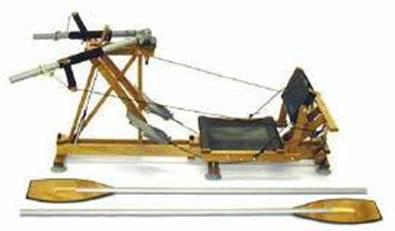
02885 aquamotion@juno.com http://www.frontrower.com phone 1-401-247-1482 designed the
Frontrower a Front Facing Rowing mechanism which enables disabled to row with
hands, legs separately or in various combinations. |
|
original design of Frontrower by Ron Rantilla |
|
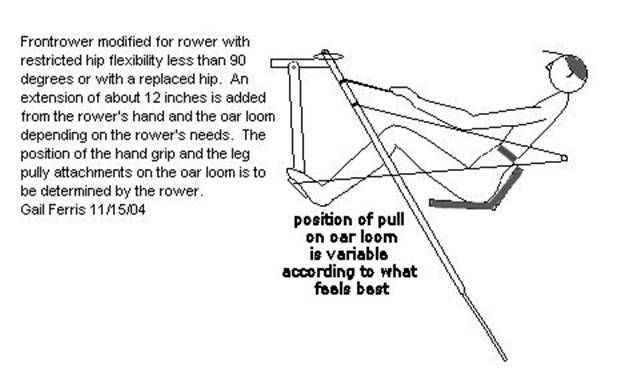
I have modified the Frontrower to accommodate my hip
limited range of motion and to get a better surge of power when surfing
downwind. Even though I have a hip replacement my hip cannot
flex more than 90°. Before I had my hip replaced I lost the
normal mobility in my hip due an osteotomy and to dysphasia and the resulting
osteoarthritis While rowing I noticed that I was unable to
comfortably execute a full sculling stroke in sliding seat and also with the
Frontrower. Through experimentation I
found that I could execute not only my most powerful stroke but also my
quickest stroke by adding a length of line threaded through semi-flexible
tubing such as irrigation or garden hose tied off on the oar loom and to the
handle. |
|
drawing of modification of original front rower note
the flexible hand holds and the low seat back inclined about 45° |
|
I developed a stroke, which integrated both flinging
my arms forward, but also flipping the oars forward with a snap provided by
my wrists. The length of my stroke was sufficient to provide
suitable propulsion in concert with my legs.
I would start my stroke with my arms and finish off with my legs. |
|
For people without use of their Ron has also designed
a canoe entry system that utilizes launching from a dock into a canoe or an
Alden at cockpit level from the dock.
Similar in concept to how I launch my kayak he utilizes a platform
structure that extends to the cockpit and Frontrower which the user slides
his body over. www.nkhorizons.com/Disabledlaunch.html
how to launch with leg prosthetics especially hip replacements. |
|
Gail
Ferris |